Wednesday, July 6, 2011

Mstuni (the bush) Adventures...

A short-term team from Crossroads Christian Church (my home church Evansville, IN) came to visit all of us at AfricaHope last month. It was wonderful...having a taste of southern Indiana here, friends, time in the bush together at the lovely school of Olosirua, & watching people experience Kenya & the people here for the fist time, just like I did 6 years ago:) We camped out next to the teacher's housing at Olosirua Primary School for 4 days. Part of the group did VBS with all the school kids, & the other part taught at a pastor's conference in a nearby town. Here's some highlights:

• Rainstorm…a badly needed rainstorm. Only a couple of the tents leaked:)
• Hyena wake-up call
• Building about 20 new desks for the students, & repairing broken chairs
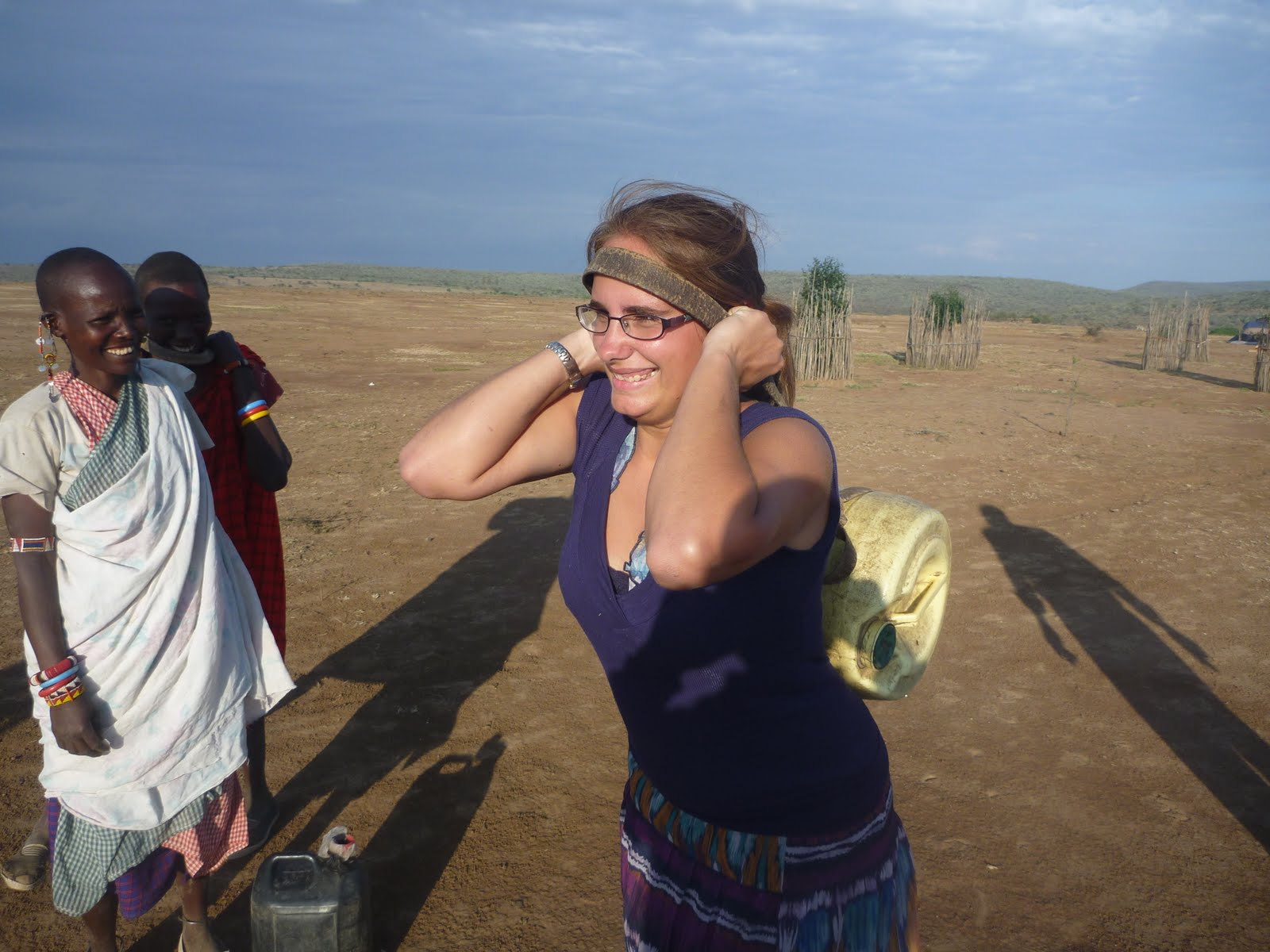
• Trying to carry water like Maasai women (place the strap tied to the large jerry can full of water on your forehead & let the jerry can hang on your back). Warning: it’s heavy & you could end up on the ground:)
• Watching the Jesus film projected on the outside of a manyata (mud hut) in nearby villages at night. Quite a few people were saved!
• Tomato sauce does not = tomato paste! Anyone know how to make spaghetti sauce with ketchup? :)
• Luncar eclipse. Amazing. And it made the stars even more radiant than they already were.
• Time around the camp fire. We ended up teaching Jackson (a co-worker of mine at AfricaHope) John Denver’s ‘Country Roads’ :)
• VBS craft time with the school kids…bags with finger print people on them, prayer journals, a banner made with handprints in the colors of the Kenya flag. Love their little hands:)

• Watching the kids play with a large parachute…you know, those parachutes we used to play with at VBS that you try to run under before it comes back down on you. It brought back memories:)
• Nashipae…the Maasai name the students gave me. It means ‘happy’:) They gave us all Maasai names after they performed some traditional Maasai songs for us on our last day there. Precious!


• Passing out deworming medication to all the students. Not glamorous, but definitely helpful.
• Visiting a nearby bore hole that AfricaHope helped make possible
• Nyama choma = roasted meat. On our last day, men from the community slaughtered a goat & roasted it for us! The goad fat soup that also comes along with a slaughtering was….an experience.
• Being able to witness a community meeting led by Tim, AfricaHope’s director, about improving the school for the children
• Maasai beaded jewelry from the parents that we were all given before leaving
• A few Moran (Maasai warriors) came by for a visit & performed a song for us! They requested that we remember them & bring back pictures. We just so happened to have a Polaroid on hand!
• Getting to know the amazing teachers & kids at Olosirua :)
I do love being out in the field:)

**If you'd like to see more pictures from our time in the bush, click here**

Sunday, July 3, 2011

Kenyan Cooking...


One of my language learning projects has been to learning how to cook Kenyan food...in Swahili. I thought I'd go ahead & share the 'recipies' I've gotten so far(translated into English as best I can:) ), so you too can try out Kenyan cooking! One warning, though...you'll probably have to use a bit of trial & error since Kenyans don't use exact measurements:) I have found exact recipies online, though, if you like exact mesaurements & directions:)

Sukuma Wiki - My favorite! It means 'to push the week' in Swahili, because it can help stretch meals through the week. This kale dish (plus spinach sometimes) is usually served with ugali (listed below) or chapati.
- Chop up onions, tomatoes, green peppers, sukuma (kale or collard greens, & spinach (if you'd like a mix)
- Put the onions, tomatoes, & green peppers in a cooking pot
- Add some cooking oil or butter/margarine
- Place over medium heat
- Leave for 5 minutes, stirring together until it is cooked well
- Add sukuma & spinach
- Add a bit of salt & water
- Cover the pot & leave to cook for 10 minutes on low-medium heat

Ugali - a dense dough-like staple of the Kenyan diet made of maize flour. It is usually served with meat, stew, sukuma wiki, or cabbage.
- Put about 4 cups of water into a cooking pot
- Bring the water to a boil
- Add about 3-4 cups of maize flour (I've seen recipies that use cornmeal if maize isn't available) a little at a time while stirring it completely together with the water using a wooden spoon
- 'Press' the mixture against the side of the pot with the spoon to continue mixing it as it thickens
- Continue cooking & 'mixing' until it is 'ready' (another recipie said 'well cooked'). Basically it should be dense, no liquid, & require muscles to stir:) The color & amount of flour required will differ depending on the type of flour you use.
- Remove the pot from the heat & cover to cool for a bit until serving
- Cut into pieces & serve

Mchuzi - aka stew
- Put peas in a cooking pot & boil them completely
- Chop the tomatoes, green peppers, cilantro, carrots, cabbage, onions, garlic, potatoes, & meat
- Put the meat & a bit of salt in another pan. Boil the meat without adding water (the salt will draw liquid out of the meat, so it won't stick to the bottom of the pan) until all the liquid is gone
- Put a bit of cooking oil in with the meat after it has cooked
- In another pot, put onions & garlic with a bit of cooking oil, & cook until brown
- Add tomatoes, green peppers, cilantro, & carrots after the onions & garlic have browned
- Cook until the tomatoes cook down
- Add the cooked meat, & cook for 2 minutes
- Add cabbage, & cook until it has changed color & the stew has soaked up all the oil
- Add peas & a bit of salt
- Add a bit of water (a larger amount if you're wanting soup), & let it boil for about 20 minutes
- Add Royco (a seasoning sold here for mchuzi), & cook for a few more minutes

Chai - Another favorite! Great on a cool day:)
- Pour milk into a cooking pot (about a 1/2 cup per person)
- Add water (about 1/2 cup per person)
- Add tea leaves (about 1/2 Tbsp per person)
- Add tea masala spice if you'd like
- Bring to a boil, & let it cook for for 2 minutes while stirring occassionally (watch closely that it doesn't boil over)
- Reduce the heat a bit after the 2 minutes, & cook until the chai becomes the color of a latte while stirring occassionally
- Pour the chai through a sieve into cups
- Serve with sugar

Ugi - a mixed flour porridge...a drinkable breakfast:)
- Put water in a cooking pot & boil (the more water, the more diluted the porridge will be)
- Mix the flour in a small bowl or cup with a bit of water (2 Tbsp of flour per person) (we used Amaranth flour, but other recipies use corn & millet flour)
- Pour the flour mixture into the pot with the boiled water
- Mix completely, making sure there are no lumps
- Leave the ugi to boil for 15 minutes
- Add a bit of milk, margarine/butter, & sugar (1 Tbsp of sugar per person)
- Leave the ugi to boil for another 5 minutes

I Will Follow...

Loving this song right now :)


"By day the Lord went ahead of them in a pillar of cloud to guide them on their way & by night in a pillar of fire to give them light, so that they could travel by day or night. Neither the pillar of cloud by day nor the pillar of fire by night left its place in front of the people." ~Exodus 13: 21-22

"When Jesus heard this, he said to him, 'You still lack one thing. Sell everything you have & give to the poor, & you will have treasure in heaven. Then come, follow me.'" ~Luke 18: 22

Monday, May 9, 2011

Bombo

One of my final assignments for my intermediate Swahili course was to give a 5-10 minute oral presentation about my experience visiting the local hospital in Tanga, Tanzania. It was challenging to do this in Swahili, not only because it’s not my first language, but also because there aren’t Swahili words for much of our English medical terminology. They either use the English word or have to just describe what they’re talking about. For example, formula = milk flour. Sometimes, you can just make a word Swahili…plexiglass = plexiglasi, incubator = incubata :) So, here is my experience at Bombo Hospital…first in English, & then in Swahili…

Bombo Experience
Last week, I went to Bombo Hospital to help one of the Norwegian nursing students with an interview for her final research paper for her Bachelor’s degree. I hadn’t been required to wear a white student nurse’s uniform like the one I was given in about 7 years! The only pair of closed-toed shoes I brought with me was pink, so I wore bright white & pink to the hospital:)
As we pulled into the hospital compound, I saw many buildings…eye clinic, tooth clinic, lab, etc. The oldest building, with a sign on it called ‘Cliff Block’, had an old-building, unique architecture feel to it that I like.

We entered the building next to Cliff Block…a more modern looking building, but run down by Western standards. We walked up a couple flights of stairs until we reached the maternity ward. Antenatal patients at less than 7 months were in a room off to the left, antenatal greater than 7 months & postpartum were in a room off to the right, & in the middle was the delivery room & Low-Birth-Weight Unit (LBW) (their NICU). The rooms were crowded…most of the beds had at least 2 women sharing them. Some had brought their own sheets of plastic to lie underneath themselves to protect the mattress from their blood. Some new mothers were resting, some were breastfeeding. The beds looked like they were decades old. Hospital personnel walked in & out of the room, but we were told there were only 2 nurses for around 60 patients! Despite the overcrowding & seemingly run down conditions, there was beauty in that room…beautiful new mothers with their precious babies, both wrapped in beautifully colored kangas.

I was able to go into the LBW unit. I kind of felt at home around those tiny babies I’m used to caring for. The room was as big as one of the NICU storage rooms at home. The incubators were made of wood with a plexiglass tops. Two new babies with retractions were in there being observed. Another tiny one was being cup fed by her mother…a method I’ve only read about in books. Another baby that looked to be about 30-32 weeks had her nasal cannula, which was hooked up to an oxygen concentrator, lying on top of her nose. I wanted to help, but wouldn’t even know where to start. Are there even the resources & knowledge here to help these sick & premature babies?

The nurse who we were going to interview was busy helping with sutures when we first arrived, but we didn’t have to wait long. She had been a nurse for 1 year – 7 months in this unit. She was so insightful, telling us about how things should be done in comparison to how they really are done. Tea (the nursing student) is writing about the effects of hygiene on maternal & infant mortality & infections, including sepsis. The nurse agreed that they’re connected & knew the importance of hygiene, but said the lack of resources, like clean equipment, lack of staff, lack of time to teach patients, & lack of general hygiene knowledge in patients are all obstacles. She seemed to have the knowledge, but is limited on her ability to implement it. She explained that they work 12+ hour shifts with little to no breaks, caring for up to 30 patients a piece, while also cleaning the ward. It sounded like nursing in the States 100 years ago. They don’t have time to teach. They don’t’ have time to assess the patients like they know they need to. They rely on the mothers to tell them if the baby isn’t acting right. They do their best, but know it’s not enough. They try to encourage breastfeeding, but have no time to teach, so the mother’s give up easily & give formula. They try to tell them to be clean, especially the breasts while breastfeeding, & the umbilical cord, but don’t’ know if they mothers really do it because they’re unable to reinforce it. Nursing as a profession isn’t respected highly in the community, so it’s not desirable to stay at a challenging job like this nurse has.

I’m glad I got to visit Bombo. The medical system here faces many challenges, but so did the Western world many years ago. They continue on here, & will also succeed.


Ujuzi wa Bombo
Wiki ijayo, nilikwenda Hospitali ya Bombo kusaidia mwanafunzi Mnorwei mmoja wa uguzi. Na mahojiano kwa mwisho karatasi yake ya uchunguzi kwa digrii yake ya Bachelor’s. Sijahitaji kuvaa nguo nyeupe ya kazi hospitali kama miaka saba! Nilileta jozi ya viatu moja tu kwamba siyo ndara, ambavyo la pinki, kwa hiyo nilivaa rangi ya nyeupe sana na la pinki kwenda hospitali. Tukiingia kiwanja cha hospitalini, niliona majengo mengi…kliniki kwa macho, kliniki kwa meno, lebu, kwk. Jengo kuukuu kabisa, liliyokuwa na alama ambayo ilisema “Cliff Block”, jina usanifu majengo ya Ulaya na wakati uliopita ninayependa.

Tuliingia jengo kondo ya Cliff Block…jengo jilifanana la kisasa zaidi, lakini kupotewa na nguvu na sanifu ya magharibi. Tulikwea ngazi mpaka tukafika wardi ya wakina mama. Wagonjwa hawajaofika mwezi saba kabla ya kuzaa, walikuwamo chumbani cha koshoto, na wale wameofika mwezi saba au zaidi, na wale wamezaa walikuwamo chumbani cha kulia. Katika katikati, palikuwa chumba cha kujifungua na wardi ya watoto wachanga waliozaliwa wenye uzito udogo au kabla ya wakati wao. Vyamba vilikuwa kusongana…vitanda karibu vyote vilikuwa na wanawake wawili au zaidi kushiriki. Wanawake wengine wameleta vipande vya plastiki wao wenyewe kupata chini ya wao wenyewe kulinda magodoro kwa damu wao. Mama wapya wengine walipumzika, wengine walinyonyesha. Vitanda vilifanana na vilikuwa vya kuukuu sana. Wafanya kazi wengi wa hospitali waliingia na waliondoka chumba, lakini tuliambia kulikuwa waguzi wawili tu kutunza kama wagonjwa sitini. Hata kama kusongana sana na kwamba wardi kulifanana na hali ya kupotewa na nguvu, kulikuwa uzuri katika chumba kile…
mama wapya wazuri na watoto wachanga wao, wote wamevaa kanga yenye rangi nzuri.

Niliweza kwenda ndani ya wardi ya watoto wachanga waliozaliwa wenye uzito udogo. Nilisikia kama nyumbani kuzunguza watoto wachanga wale wadogo sana kama wale nilizoea kutunza. Chumba kilikuwa ukubwa cha chumba ya akiba nyumbani. Incubata walitengeza mbao na plexiglasi juu ya upande wa juu. Watoto wachanga wapya wenye ‘retractions’ walikuwepo kuangaliwa. Mwengine mdogo sana aliliwa kwa kikombe na mama yake…njia nimesoma kuhusu tu vitabuni cha kiada. Mwengine aliyefanana amefika wiki thelathini au thelathini na mbili, alikuwa na kitendea kazi changu ya oksijeni juu ya pua yake. Nilitaka kusaidia, lakini sikujua kukoanza. Kweli…wana vifaa vya kutosha hapa kwa kuwasaidia wale watoto wachanga wagonjwa na wale kabla ya wakati wao?

Mwuguzi tuliyekuwa kuhoji alishughulika kusaidia kushona tukifika, lakini hatuikuwa na muda mrefu siku hii. Amekuwa mguguzi kwa miaka moja - miezi saba katika wardi hii. Alikuwa na ufahamu sana, kutuambia kuhusu jinsi ya vitu vifanye kufananisha jinsi ya vyao vinafanywa. Tea (mwanafunzi wa uguzi) anaandika kuhusu jinsi ya elimu ya afya kugeuza mauti ya mama na watoto wachanga na maambukizi, hasa septicemia. Mwuguzi alikubali kwamba vitu hivi vinashirikiana na alijua maana ya elimu ya afya, lakini utovu ya vitu vinavyosaidia kama vifaa maalum safi, wanafany kazi, wakati kufundisha wagonjwa, na maarifa ya kawaida wa wagonjwa kuhusu elimu ya afya. Alionekana ana maarifa, lakini ni kuwekwa mpaka katika kuwezwa kuyafikiliza. Alieleza kwamba walifanya kazi zamu ya kazi ya saa kumi na mbili au zaidi na mapumziko ya dogo au hata moja. Walitunza mpaka wagonjwa thelathini maadamu pia kusafisha wardi. Hii ilinikumbushe ya uguzi katika Umerika miaka mia moja uliopita. Hawana wakati wao kufundisha. Hawana wakati kuwapima wagonjwa wao kama wanajua wanahitaji kufanya. Wanawategemea mama kuwaambia kama mtoto mchanga hatendi sahaki. Wanafanya kazi yao bora kabisa, lakini wanajua wanajaribu kutia moyo kunyonyesha, lakini hawana haitoshi wakati kufundisha, kwa hiyo mama wanacha rahisi na kuwalisha na unga ya maziwa. Wanajaribu kuwaambia waki mama kuwa na usafi, hasa maziwa zao maadamu kunyonyesha na chango la uzazi, lakini hawajui kama mama kuifanya atafanye kwa sababu hawawezi kujimarisha. Mwuguzi pia alituambia kwamba ubingwa wa uguzi haukustahi sana kwa jamii, kwa hiyo hakuna motisha kubaki katika kazi ambaye inakuwa ngumu kama hii.

Mimi ninafurahi niliweza kutembelea Bombo. Pana mazingira ya kazi magumu hapa, lakini mazingira haya, sisi pia tulikuwa nao Ulaya na Amerika. Wanaendelea mbele hapa na wao pia watafika.

~~~~~~~~~~~~~~~~~~~~~~~~~~~~~~~~~~~~~~~~~~~~~~~~~~~


Nurses’ Duties in the US 100 Years Ago
The following job description was given to floor nurses in institutions similar to Athens’ Lunatic Asylum (circa 1887).
In addition to caring for your 50 patients, each nurse will follow these regulations:
1. Daily sweep and mop the floors of your ward, dust the patient’s furniture and windowsills.

2. Maintain an even temperature in your ward by bringing in a scuttle of coal for the day’s business.

3. Light is important to observe the patient’s condition. Therefore, each day fill kerosene lamps, clean chimneys and trim wicks. Wash the windows once a week.

4. The nurse’s notes are important in aiding the physician’s work. Make your pens carefully you may whittle nibs to your individual taste.

5. Each nurse on day duty will report every day at 7 a.m. and leave at 8 p.m. except on the Sabbath on which day you will be off from 12 Noon to 2 p.m.

6. Graduate nurses in good standing with the director of nurses will be given an evening off each week for courting purposes or two evenings a week if you go regularly to church.

7. Each nurse should lay aside from each payday a godly sum of her earnings for her benefits during her declining years so that she will not become a burden. For example, if you earn $30 a month you should set aside $15.

8. Any nurse who smokes, uses liquor in any form, gets her hair done at a beauty shop, or frequents dance halls will give the director of nurses good reason to suspect her worth, intention and integrity.

9. The nurse who performs her labors and serves her patients and doctors without fault for five years will be given an increase of five cents a day, providing there are no hospital debts outstanding.
http://www.toddlertime.com/advocacy/hospitals/Asylum/ridges-staff.htm

Language is Culture...Part III: TICC


If you have read some of my most recent posts, you won’t be surprised to hear that…language is culture. While in the coastal town of Tanga, Tanzania for the past 6-weeks completing an intermediate Swahili course with some teammates, I continued to learn about the new culture surrounding me. Despite some differences - Kenyans seems to first identify themselves more by their tribe, whereas Tanzanias seem to first be…Tanzanias, & a coastal culture is different from an inland culture, especially seen in the different foods they eat (lots of fish, fruit, & coconuts!), different jobs (lots of fishermen),
& a higher prevalence of the Muslim religion - there is definite similarities in Eastern African cultures in the basic ways people live. There was another culture I learned about that I wasn’t expecting…Norwegian. This probably surprises you, too:) Well, the owners of the school are Norwegian. They are involved in many development projects around Tanga, including contracts with a number of Norwegian universities to provide some international community health nursing courses. The Norwegian nursing students & their professors were excited to share their ‘brown cheese’
& homemade bread breakfast, & we were fortunate enough to be a part of their just because traditional Christmas dinner in April:) They were even more excited that we liked it! The Maasai guards at the school added another cultural element…jumping contests & chanting followed by Celine Dion songs on the radio, protecting us from snakes, & learning that they don’t like fish & are scared of crabs…but no fear of lions, mind you:) And then there was the night everything merged together….watching the movie ‘The White Maasai’ in Norwegian with our new friends that translated for us the best they could:)


Speaking of food, I loved the coastal food! When I first arrived, I stayed in a village a 20 minute walk away from school, called Mchukuni,
for 1.5 weeks Every evening, Mama Mwalimu (the lady of the house) cooked the most delicious meals – combinations of rice cooked with coconut milk, ugali (the really dense porridge also popular in Kenya), tomato based stews of vegetables & fresh fish caught by the fishermen in the village, bananas, & fruit to top it all off. All of this was cooked from scratch on a jiko (charcoal cooker) outside, just like in Kenya.
The concrete block house I stayed in was owned by the Mwalimu family, one of the wealthiest families in the village. They had running water & elecriticy (praise the Lord!), but no fans in the bedrooms, which led to some very, very, very hot night topped off with about 100% humidity. I don’t think I’ve ever sweat so much in my life! Some nights, required a quick shower to cool off just to try to get back to sleep. But, this is the life they know & live. Every morning as I ate breakfast (chapatti or a deliciously sweet & dense ‘rice bread’ with ginger chai), I watched women & children come to the house to fetch water…the only tap & clean source of water I knew of in the area. If they couldn’t balance the huge plastic containers full of water on their head, they weren’t as respected by people. Did I mention how impressed I am with African women? Since the Mwalimu’s (Swahili for teacher) house was one of only a few places in town that had electricity, people would bring their cell phones to them to be charged. This is a really popular business in East Africa…probably over most of the developing world. They were also one of the few people that owned a TV, so we had many visitors in the evening when it came time for the English-dubbed Spanish soap operas…that made me feel like I was back in the village in Kenya:) Every evening, Mwalimu (the man of the house) went to the mosque for prayer. Muslim prayer is ‘kusali’ (to pray) in Swahili, whereas Christian prayer is ‘kuomba’ (to ask or beg). Parties were a frequent thing in the village, especially in the evenings when it was slightly cooler.
One wedding lasted from Thursday night until Monday morning at 7am! Some nights, we were taunted by drunken bush babies (a furry creature with a long tail larger than a squirrel) that get into the local brew, & dance around on the roof & crack coconuts:)

Life at TICC was much more Western, but we were surrounded by the Tanzanian staff & our teachers.
Everyday consisted of 2 hours of class (in our outdoor classroom:) ), 1-2 hours of Rosetta Stone, & practical time speaking with the staff. Our main textbook was a book called Simplified Swahili, which was written by an Mzungu (aka Westerner) back in the day, so it matched our Western train of thought & learning styles. I didn’t realize this until the day our teacher taught from a different book written by a Tanzanian….I felt like he was jumping around all over the place & teaching small parts of many different topics that didn’t fit together. Language is culture.
There were 1st to 4th grade reading books available for us to learn from, also. I saw a sad theme in too many of the stories that were similar to something I wrote about in a previous blog….death, sickness, brokenness, destruction. One of the stories depicted a herd of cows getting killed by a train, another, a mother so sick & vomiting that she was hospitalized, & another was titled ‘Father, don’t kill me’! Not all of the stories were like this, but it was enough to get a glimpse into the different culture, the different practical things children have to be taught, the different life here.

A couple of hours each day was spent speaking Swahili with the staff. We learned Swahili words about the kitchen, housekeeping, fishing, maintenance, etc. I even got to try out kufyeka (slashing grass) with a panga (machete)!
As we got to know these people, they became our friends. Those that were Christians invited us to their churches on Sundays…another good practical Swahili experience. A teammate of mine began reading the Bible with a Muslim friend, nicknamed Simba (‘lion’):)…it was mutually beneficial Swahili & English practice, & well, you know, the Word. If you’ve ever read from the King James Version of the Bible, you know it doesn’t use every day English. Well, it’s kind of the same with the Bible in Swahili….it’s grammar is very advanced & the words used aren’t every day words.
Please pray for Simba as he is hungry to continue learning more. One day a group of us rode bikes to the nearby village of Mwahako to check on some TICC sponsor kids, and play soccer & sing with them. We had renditions of ‘Head, Shoulders, Knees, & Toes’ going on in English, Swahili, & Norwegian:) Towards the end of the course, Mama Ruth (the makubwa…aka boss of TICC) had Elizabeth (a teammate & fellow nurse) & I go with some of the Norwegian nursing students to the local clinics & hospital to help translate for interviews in the delivery wards.
It was like a breath of fresh air to be in a medical setting again, especially when I got a glimpse of their Low-Birth-Weight Unit…my NICU:) One of our final assignments was to do an 5-10 minute oral presentation about our experience in Swahili. Be looking for that as my next blog…

I’m now back in Narok, trying to get settled-in to life in Kenya, & use the Swahili I’ve learned. There’s always more language & culture to learn…so, here it goes!

**If you'd like to see pictures from my experience, click here**

Wednesday, March 9, 2011

Language is Culture...Part II: Homestays


I recently completed 1.5 months of homestays with Kenyan families to help with enculturating & language learning. The father of both families are co-workers of mine at AfricaHope...one family lives in Narok (the same town I live in) & the other lives in a more rural town out in the 'bush' a 1.5-2 hour drive south of Narok. Both of these experiences gave me a glimpse into the lives of Kenyans here, at least for families that are on the more 'well-off' side. I spent quite a bit of time during both homestays studying Swahili, too, with their daughters that were home from school. We used a lot of the techniques that I learned about in my training in Colorado last summer...I had fun & I hope they did, too:) The same rang true with language leraning with a language helper & homestays as with language school....Language is Culture! Here's some of the things I remembered to write down:

- My name has changed: it's really difficult for Kenyans to pronounce my name...it always comes out as "Kate"...plus, "Katie" to them sounds too much like kati (Swahili for 'time') & kiti (Swahili for chair/couch), so they get pretty confused sometimes when I'm introduced

- Toilet talk: all cultures are different as far as what is appropriate to say. Here, you do not say, "I'm going to the choo" (choo = toilet), you say, "I'm going to help myself". I had one Kenyan friend tell me I was going to the 'relief office' :)

- Reality: I asked the girls to help me write sentences using words of objects that I'm trying to learn...a common theme I saw was about things being 'broken', 'stolen', 'dirty', or 'clean'...frequnt realities of life here & what so many women's lives revolve around. I wanted to find the word for ceiling , but when they wrote a sentence for me it translated, "They hid money in the roof."...I was confused. The girls said, "Aren't roof & celing the same thing? Most people don't have a ceiling. And they do hide their money in the grass roofs." The Swahili words for bake & steam were also unknown to them...they don't cook those ways...they don't have an oven. Another sentence did bring some humor...I had found the phrase for 'kitchen sink' (beseni la kuoshea vyomba vya bafu...a fete considering most families in rural areas don't have running water & therefore use basins instead), but my friend wasn't familiar with this combination of words & only registered 'basin' --> "I lost the kitchen sink" :)

- Different meanings: the same word means different things not only across languages, but also accross locations & cultures. I was talking about my bibi one day...grandmother in Tanzanian Swahili, but wife in Kenyan Swahili...opps! So, now if I go back to Tanzania & talk about my nyanya (grandmother in Kenya), they're going to think I'm talking about my tomato :) Uwanja wa ndege ('field of airplanes') = airport (which, when taken apart, seems to be a 'port for the air') Dawa la meno ('teeth medicine') = toothpaste ('paste for teeth') P.S. 'Narok' (the town I live in) apparently means 'hell' in Thai!!! Hell's Gate National Park is nearby :)

- Word construction: as I learn the literal means of words or phrases, it's easy to see that language develops as the culture develops, & words are created in the context of what is already known. For example, in Swahili, disappointed = kosa tumaini (literally 'to lack hope'). You can see this in English, too....breakfast = 'to break the fast'. It's kind of beautiful to see a language in this way...

- The English bubble: things don't always (actually, usually don't) translate literally into English...each language is it's own, why would it fit into the English bubble?...but that can be hard to remember & thus causes frustration sometimes. The frustration can go both ways, though...how would one go about describing why we call 'tank tops' tank tops????

- Culinary limits: different peoples stomachs tolerate different things, let alone different cultures with the foods we're used to! Milk (maziwa), for example, in the Maasai culture is a staple of their diet. You can find maziwa lala ('sleeping milk') in the supermarkets, aka "yogurt" as described to me. I've also heard of the famous Maasai 'sour milk', with the steps of kuharibkia ('to spoil'...no particles yet, but it smells) to kuganda ('to freeze'...soured with particles to which lots of sugar is added). I don't know if my stomach would 'sleep' through the night with that...


Some challenges:
- Have I turned into an 'interrupter'??? How do you know when it's approritate to say something when you don't understand what they're talking about? And by the time you do translate in your head enough to know what they were talking about, are you now saying a totally random thing off topic?! :)

- The 'right way' vs the 'ministry way'...this is a big challenge for me because I like to do things the 'right way'. I began my Swahili study in Tanzania where Swahili is 'purer' (Swahili was born in Zanzibar, grew-up in Tanzania, & died in Kenya), but then did homestays in rural Kenyan where proper Swahili is taught in school, but is definitely not spoken the same way ("Why would anyone choose to speak less 'intelligently' than they're taught?! Oh, yeah...we do this in the States all the time!"). Where do I put my efforts...learning Swahili by the books or by learning how the people I'll be working with speak it (even when I know it's 'wrong' & goes against my perfectionist grain)??? Do I want to 'fit in' or be the equivalent of a British person speaking in the South in the States???

- "If I don't know how to say it in Swahili, I just shouldn't say anything"...right? Probably wrong. Warning: This leads to a decrease in interactions with the people around you, & therefore decreased relationships. That can get pretty lonely...

- Dictionary vs person...who to trust? Well, it turns out both are 'right' at different times depending on how the language is used in the area you're in. This definitely led to some frustrations when I thought I'd learned a word I looked up only to find out that's not how it's used here...kusali means 'to pray' in Swahili, but not in Narok it's how Muslims pray! Note to self: say omba when I want to pray:) But, the dictionary is still my friend...my language helpers & I reference it all the time!

- 'Good' days & 'bad' days...when I seemed to be having a 'good' day with language, I would have a 'bad' day with culture shock. When I'd have a 'good' day with culture, I'd have a 'bad' day with language. The days that both aspects were 'good' seemed rare, but....really good :)


Some new experiences during my homestay time:

- listening to the radio while hanging out & relaxing in the afternoons...I've gotten used to only listening to the radio in the car on occassion

- watching a chicken be slaughtered, cooked, & then placed onto my plate for dinner...surprisingly I had no aversion to eating the tastey dinner

- diarrhea on an outdoor squaty-potty outhouse...perhaps too much information for some people, but hey, it's inevitable when living overseas :)

- reading by flashlight at night after the solar power ran out...this usually lead to an earlier bed time than I'm used to

- brushing my teeth outside underneath the breathtaking stars at night

- old time country & gospel music are still alive & well in Kenya :)

- watching a friend eat dirt that she picked up while walking by the shamba (farm), which she said is a really common snack for women...it's even available for sale in the supermarket! She was recently pregnant, probably had malaria at some point, & now is anemic (odd cravings that come along with anemia like this is called pica in the States, for which people take iron tablets for months, but it's not readily availbe here, & if they do take it & don't see quick results after a week they stop)

- I went to visit a friend & was served: chai x2 (of course!), hard boiled eggs, gum, & 'medicinal' tea :)

- meeting iliterate adults & children that have never been to school nor never will...I didn't realize how prevelent this still is here, despite there being laws about kids going to school (there's just not the personnel out in rural areas to enforce this, & some families still don't see the need for an education)

- an 8 hour church service, part of which was a celebration of a CD the choir had recorded & is now selling...it was long, but also filled with beautiful dancing & praising God

- I felt like I was on the way to becoming part of the family, not just a guest, when the mother of the family told me "Karibu dada" (welcome sister) & held my hand as we walked through the market (a common things for friends to do in this culture...for men & women)


**If you'd like to see more pictures from my homestay experiences, click here**